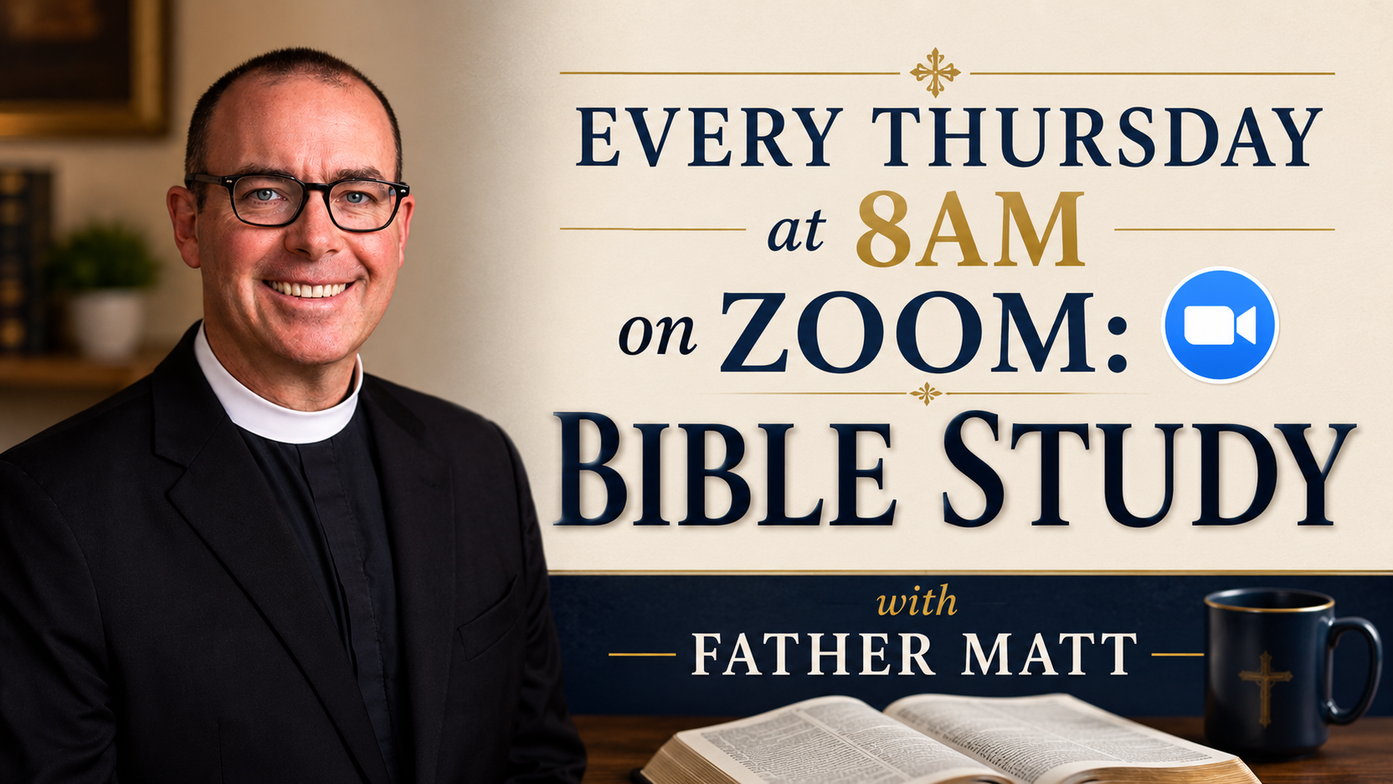
On Thursdays (as announced) from 8:00 am to 8:45am Father Matt leads a Zoom Bible Study. Join using this Zoom Link (PW “BOLTON”). Each Bible Study will be recorded and posted to our YourTube Page, so you can catch it later if you miss the live version.
Father Matt leads Bible study as a prayerful, communal act of close reading. Sessions begin in prayer and proceed through the text patiently, often verse by verse and book by book over many weeks. He asks participants to read aloud, invites questions and observations, and allows the conversation to shape the route through the material. Although he prepares background and commentary, he functions less as a lecturer delivering predetermined conclusions than as a priest-teacher and facilitator. His humor, curiosity, and admissions such as “I don’t know” help create a setting in which serious interpretation can remain hospitable.
His teaching method is layered. He begins with what a passage may have meant in its original literary, political, and religious setting. He draws on history, archaeology, geography, literary structure, and the social worlds of Israel, Second Temple Judaism, and the Roman Empire. Hebrew and Greek terms, the Septuagint, manuscript questions, and competing English translations are recurring tools. He compares parallel Gospel accounts and acknowledges tensions, editorial choices, and uncertainty instead of forcing artificial harmonization. Scholarship serves the life of faith: it clarifies what the text can responsibly bear and protects the group from easy but misleading answers.
From that historical foundation, Father Matt traces how later biblical writers and the Church receive a text. He distinguishes an Old Testament passage’s first horizon from its Christological use without treating the earlier meaning as disposable. This produces a deeply Christian reading that also respects the integrity of Jewish Scripture and resists anti-Judaism and supersessionism. Scripture emerges as a network of remembered images—creation, exodus, covenant, temple, exile, kingdom, cross, resurrection, and new creation—rather than as a collection of isolated proof texts.
Theologically, Father Matt’s approach is best described as critically informed, creedal, and sacramental Anglican catholicism. He is comfortable with historical-critical scholarship and with recognizing the human processes by which Scripture was composed and transmitted. At the same time, he teaches from within the Church’s worship and affirms the Incarnation, the Resurrection, the Trinity, Baptism, and the Eucharist. His Eucharistic teaching is notably realistic and strongly connected to the Last Supper, John 6, Pauline tradition, and the Church’s liturgical practice. Grace is central: God’s kingdom overturns ordinary calculations of merit, status, power, and reward, calling disciples toward service rather than privilege.
Father Matt does not avoid difficult material. Violence, slavery, suffering, judgment, empire, anti-Jewish interpretation, and apparent contradiction are addressed directly. His usual movement is from context, to careful interpretation, to ethical and pastoral application. Prophecy and apocalyptic are read through genre and their ancient imperial settings, not as coded timetables for modern speculation. Across the studies, his aim is formation rather than mere information: to teach people how to read Scripture patiently, intelligently, reverently, and together. Participants are invited not to master the Bible, but to be questioned, corrected, consoled, and transformed by it. The governing posture is faith seeking understanding—confident in the Gospel, honest about uncertainty, and attentive to how the biblical witness forms a community for worship, justice, humility, and Christlike service.