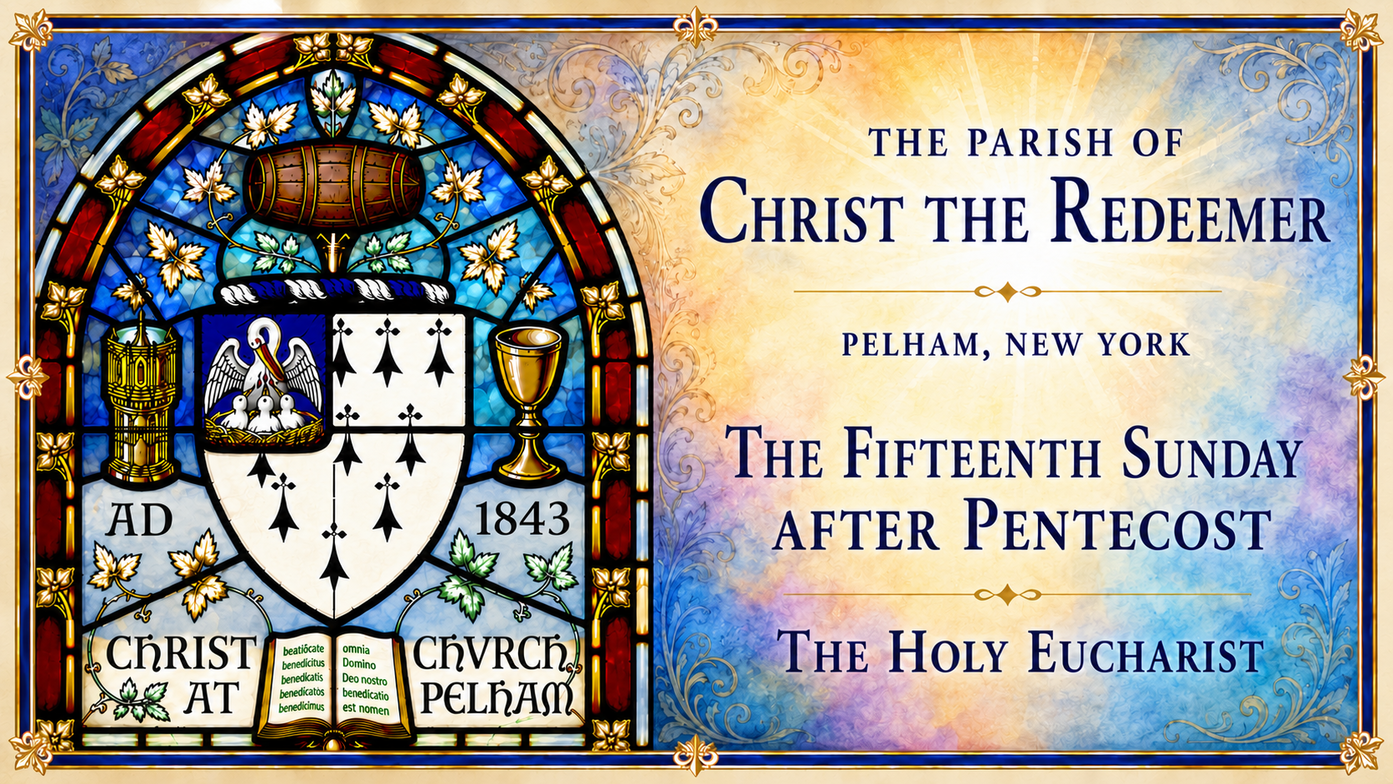
Services & Preacher
- 8:00am: Said Eucharist (Church)
- 10:00am: Holy Eucharist with Hymns & Organ Music (Church)
- Preacher: Father Matt
Events & Fellowship
- 10:00am: Nursery Care (Ranck Building)
- Coffee Hour follows each service.
Donate & Give to Support Christ Church
- Donate to Christ Church HERE.
- Our 2026 Pledge campaign has begun. Make you pledge today online. Our goal is 150 pledges for more than $550,000.
Livestream Feeds and Bulletins
- A PDF of the 10am Service Leaflet is available below.
- The Livestream link is below.
- Livestreams for all of today's services and all prior weeks can be found HERE.
About Worship Today
- This period in the Church year is known as “The Season after Pentecost” or “Ordinary Time.” The term “ordinary” refers to how the New Testament passages are generally read in order or in sequence, as opposed to being arranged by specific theme as in other seasons. During this season the Gospel passages focus on Jesus’ ministry, how he is revealed to the world as the Christ, and what he teaches to his followers. In Year A (the first in a three-year cycle: A, B & C) most of the Gospel passages are from the Gospel according to Matthew. When Track 1 is used, the Old Testament Lesson is read in thematic sequence throughout the summer, in Year A we will read from the Pentateuch (first five books of the Bible). The New Testament Lesson is independent of these readings and is almost always taken from one of the Letters in the New Testament that reflects the common life and mission of the first Christian community.
- The Holy Eucharist, the principal act of Christian worship on the Lord's Day and other major Feasts, and Daily Morning and Evening Prayer, as set forth in the Book of Common Prayer, 1979, are the regular services appointed for public worship in the Episcopal Church. At Christ Church we celebrate the Holy Eucharist every Sunday, and also on Holy Days and other occasions.
- Today’s liturgy is from the red Book of Common Prayer 1979. All hymns are taken from the blue Hymnal 1982 or other authorized hymnals for use in the Episcopal Church. All hymns are reprinted with permission under OneLicense.net A713125.
- Today's Lessons can be found at the Lectionary Page (Track 1)
10am Service Order:
- Prelude: Unter der Linden grune by Jan Pieterszoon Sweelinck 1562-1621
- Processional: #561, Stand up, stand up, for Jesus, Morning Light
- Gloria in excelsis: S-280, Powell
- The First Lesson: Exodus 12:1-14
- Gradual: Psalm 149
- The Second Lesson: Romans 13:8-14
- Sequence Hymn: #379, God is Love, let heaven adore him, Abbot's Leigh
- Gospel: Matthew 18:15-20
- Offertory Organ Voluntary: Improvisation by Bischof
- Offertory Doxology: #380, vs 3, Old 100th
- Sanctus & Benedictus: #S-130 from Deutsche Messe, Franz Peter Schubert (1797–1828); arr. Richard Proulx (b. 1937)
- Agnus Dei: #S-161 from New Plainsong; David Hurd (b. 1950)
- Communion Organ Voluntary: Improvisation by Bischof
- Postcommunion Hymn: #541, Come labor on, Ora labora
- Processional: Allemand by Sweelinck
Prayer List:
- Our prayers are asked for Sean our Presiding Bishop, Matthew and Allen our Bishops, Father Matt our Rector, Mother Meredith, Deacon Chisara, and our Wardens, Officers, and Vestry members. We pray also for: Edward, Cathy, Annette, Patricia, M&D, Dan, Heidi, Brian, Marion, Fronda, Coulby, Michael, Jane, and Sandy. We pray for those in our Armed Services. We also pray for those who have died. We give thanks for those celebrating birthdays this week: Lisa Doughten (9/12), Aedan Pearl (9/10), Henry Russo (9/12), Davina Salvatore (9/11)
Dr. J's Notes:
- Jan Pieterszoon Sweelinck was one of the most influential keyboard composers in the history of Western music and a pivotal figure in the transition from the Renaissance to the Baroque. Born and active in Amsterdam, he spent nearly his entire career as organist of the Oude Kerk, where his extraordinary improvisations attracted students and visitors from across northern Europe. His keyboard music—including fantasias, toccatas, variations, and chorale settings—combines the contrapuntal mastery of the Renaissance with the emerging virtuosity and expressive freedom of the Baroque era. Particularly celebrated are his monumental fantasias, in which a single musical idea is developed with astonishing ingenuity and architectural coherence. Through the many German students who traveled to study with him, he became known as the “maker of organists,” exerting a profound influence on the North German organ school that ultimately culminated in the music of Dieterich Buxtehude and Johann Sebastian Bach. His organ music remains admired today for its intellectual rigor, expressive depth, and timeless beauty, securing his place as one of the foundational figures of the organ repertoire.
Downloads
Worship At Christ Church
Worship Services